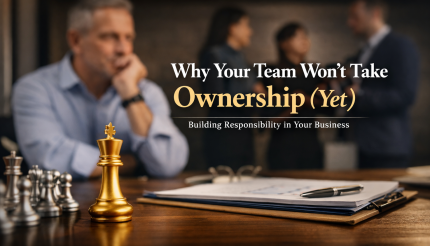
 Imposter Syndrome in Business Owners Who “Should Know Better”
If you’ve been running a business for years – maybe even decades – imposter syndrome can feel embarrassing.
You’ve built something real. You employ people. You’ve survived tough markets, difficult decisions, and long hours. On paper, you’re successful. Yet there are moments when a quiet voice says:
“One day, someone’s going to realise I don’t actually know what I’m doing.”
For many business owners, that thought isn’t occasional. It’s constant. It often gets worse the more the business grows.
What Imposter Syndrome Looks Like at This Level
Imposter syndrome in experienced business owners rarely looks like panic or insecurity on the surface. Most owners function perfectly well day to day.
Instead, it shows up in subtler ways:
-
Re-checking decisions you’ve already made
-
Hesitating before making strategic moves
-
Feeling pressure to appear confident even when you’re unsure
-
Avoiding long-term planning because it feels uncomfortable
-
Staying busy to avoid confronting bigger questions
You may even be the person others turn to for advice – while privately questioning yourself.
Why It Often Starts After Success
Early in business, uncertainty feels normal. You’re learning, experimenting and expecting mistakes.
But as the business grows, expectations change – especially the ones you place on yourself.
At this stage, many owners start believing:
-
“I should have this figured out by now”
-
“Other owners seem more confident than me”
-
“If I ask for help, it means I’m failing”
-
“My team expects me to always know the answer”
The reality is that success doesn’t eliminate uncertainty – it exposes it.
As the business becomes more complex, decisions carry more weight. There’s more at stake: employees, families, reputation, financial security. Doubt becomes harder to ignore.
The Hidden Cost of “Looking Confident”
One of the biggest problems with imposter syndrome is that it encourages owners to perform confidence rather than seek clarity.
This often leads to:
-
Delayed decisions because nothing feels “certain enough”
-
Holding onto too many responsibilities
-
Avoiding difficult conversations
-
Choosing familiar options over better ones
-
Remaining reactive instead of strategic
Over time, this can trap owners in the business rather than allowing them to lead it.
“Everyone Else Seems to Know What They’re Doing”
Comparison fuels imposter syndrome.
You see other business owners online, at networking events, or in your industry and they seem calm, decisive, and in control. What you don’t see are the doubts, second-guessing and uncertainty happening behind closed doors.
The difference isn’t confidence.
It’s support and structure.
Most successful owners don’t rely on instinct alone – they rely on frameworks, advisors, mentors and accountability.
Why Motivation Isn’t the Answer
Imposter syndrome isn’t solved by:
-
Positive thinking
-
More motivation
-
Working harder
-
Waiting until you feel ready
Those approaches tend to make the problem worse by putting all the pressure back on you.
What actually helps is removing the guesswork from decision-making.
From Self-Doubt to Strategic Confidence
Strategic confidence doesn’t mean having all the answers. It means:
-
Knowing how to evaluate options clearly
-
Having a process for making decisions
-
Being able to step back from emotion
-
Turning uncertainty into action
-
Not carrying the entire burden alone
This is where many business owners experience a shift – not because they suddenly feel more confident, but because they stop relying on confidence altogether.
Why Experienced Owners Often Seek Coaching
Business coaching isn’t about fixing broken businesses.
It’s about supporting capable owners who:
-
Have outgrown trial-and-error
-
Want clearer direction
-
Need space to think strategically
-
Are tired of carrying everything alone
-
Want the business to work for them, not because of them
For many owners, the biggest relief is simply realising that doubt is not a personal failing – it’s a leadership signal.
You’re Not Behind – You’re at a Turning Point
If you recognise yourself in this, it doesn’t mean you’re not good enough.
It usually means your business has reached a level where doing it alone no longer makes sense.
Imposter syndrome often appears right before growth – not because you’re incapable, but because the business is asking something new of you.
And no one builds something meaningful without support along the way.